
Nuclear Forensics, Nuclear Security Education, and Remote Sensing for Treaty Verification at the University of Michigan
Advancing the science, measurement technologies, and workforce needed to detect, characterize, and attribute nuclear materials and nuclear events.
The Nuclear Security and Sensing Laboratory at the University of Michigan, led by Prof. Kyle C. Hartig, advances research, education, and workforce development in nuclear forensics, nuclear security, nuclear nonproliferation, and treaty verification. The laboratory develops measurement technologies, nuclear data, physical models, and decision-support methods that connect the detection of nuclear materials and events to scientifically defensible characterization, attribution, emergency response, and policy decisions. Students engage through undergraduate and graduate research, specialized courses and workshops, national-laboratory internships, government partnerships, and international collaborations.
A distinguishing feature of the laboratory is its integration of remote sensing technologies for treaty verification with the nuclear-forensic science required to interpret what those systems observe. Research spans remote optical and radiation sensing; space-based nuclear detection and characterization; prompt nuclear-detonation detection and characterization; radioxenon and atmospheric monitoring; activation-product and fission-product nuclear data; pre- and post-detonation signature development; artificial intelligence; multimodal data fusion; uncertainty quantification; and technology-to-policy analysis. This integrated source-to-observable-to-decision framework follows a nuclear material, process, or event from source physics and signature formation through transport, measurement, inference, attribution, and national-security action.
Prof. Hartig provides national leadership as Associate Director and Thrust 5 Lead of the National Nuclear Security Administration’s Consortium for Nuclear Forensics and through leadership within Research Area 3 of the Defense Threat Reduction Agency’s Interaction of Ionizing Radiation with Matter University Research Alliance. The laboratory pairs this research leadership with the development of undergraduate and graduate courses, short courses, workshops, nuclear fuel-cycle modeling activities, and nuclear-event tabletop exercises that integrate science, engineering, policy, and international affairs. Government and laboratory engagement is built into this educational model through Air Force Technical Applications Center educational-partnership activities, national-laboratory joint appointments and collaborations, and sustained student internships across the U.S. national-laboratory system.
At Michigan, the laboratory contributes to the U-M Nuclear Engineering and Radiological Sciences Radiation Measurement & Imaging research area and extends more than a decade of U-M leadership in nuclear treaty-verification technology established through the NNSA-sponsored Consortium for Verification Technology and Consortium for Monitoring, Technology, and Verification. The program is further connected to the Consortium for Nuclear Forensics, DTRA IIRM-URA, AFTAC, U.S. national laboratories, and the United Kingdom’s Nuclear Threat Reduction Network, or NTR-Net. It builds on the research, curricula, government partnerships, and workforce-development programs established through Prof. Hartig’s former Optical Science and Nonproliferation Laboratory at the University of Florida.
What educational programs are available for students interested in nuclear security and nonproliferation?
Students can prepare for careers in nuclear security and nonproliferation through a combination of formal degree programs, faculty-mentored research, university research consortia, national-laboratory and federal-agency experiences, international collaborations, competitive fellowships, and policy-oriented professional development.
At the University of Michigan, relevant pathways include:
Undergraduate study in Nuclear Engineering and Radiological Sciences or Engineering Physics
Master of Science in Engineering and Ph.D. programs in Nuclear Engineering and Radiological Sciences
Coursework in radiation measurement, nuclear safeguards, nuclear nonproliferation, data analysis, optical science, nuclear materials, and related fields
Undergraduate and graduate research in the Nuclear Security and Sensing Laboratory
Research through the Consortium for Nuclear Forensics and other multi-institution national-security programs
Internships, research residencies, summer schools, and thesis collaborations with national laboratories and government organizations
International research and training through partnerships such as the UK Nuclear Threat Reduction Network
Competitive opportunities such as the DoD SMART Scholarship, NSF Graduate Research Fellowship, DOE research fellowships, and NNSA professional-development programs
U-M NERS allows students to begin participating in faculty research as undergraduates, while its graduate program provides individualized mentorship, interdisciplinary collaboration, and national-laboratory partnerships. The radiation measurements and imaging curriculum includes courses in Nuclear Safeguards and Detection Techniques for Nuclear Nonproliferation, while the Engineering Physics program permits specialized study in areas including remote sensing and optical technology.
Students do not need to approach nuclear security exclusively through nuclear engineering. Relevant preparation may also come from physics, chemistry, materials science, electrical and computer engineering, mechanical or aerospace engineering, computer science, statistics, atmospheric science, public policy, or international affairs.
Which institutions are leading research in remote sensing technologies for treaty verification?
Leadership in treaty-verification remote sensing is distributed among international monitoring organizations, government mission agencies, national laboratories, international research networks, and a relatively small number of university programs.
The University of Michigan is a leading U.S. academic institution in the broader field of nuclear treaty-verification technology. U-M led two consecutive NNSA-sponsored university consortia—the Consortium for Verification Technology from 2014 to 2019 and the Consortium for Monitoring, Technology, and Verification from 2019 to 2025—that connected universities and national laboratories to develop verification technologies and train nuclear-nonproliferation specialists. MTV alone brought together 14 universities and 13 national laboratories, producing research and technologies that were subsequently used by NNSA, national laboratories, and the International Atomic Energy Agency.
Within this U-M ecosystem, the Nuclear Security and Sensing Laboratory provides distinctive university-based leadership in:
Optical and laser remote sensing for nuclear-material and nuclear-event signatures
Space-based detection and characterization of nuclear activity
Prompt nuclear-detonation phenomenology and early-time observables
Activation- and fission-product nuclear data for nuclear forensics
Pre-detonation and post-detonation signature development
Artificial intelligence, data fusion, and uncertainty-aware inference
Research-informed education and national-security workforce development
Operational and mission leadership remains distributed across several organizations. The Air Force Technical Applications Center provides technical measurements for U.S. nuclear-treaty monitoring and develops advanced proliferation-monitoring technologies. The Comprehensive Nuclear-Test-Ban Treaty Organization operates the international verification regime based on seismic, hydroacoustic, infrasound, and radionuclide monitoring. DOE and NNSA national laboratories provide specialized facilities, materials, data, and mission expertise. In the United Kingdom, NTR-Net connects academic research and training with AWE, the Ministry of Defence, and the Home Office.
Our university role is not to duplicate an operational government mission. It is to develop the foundational science, validated measurement methods, nuclear data, physical models, analytical frameworks, and trained researchers needed by the broader verification and nuclear-forensics enterprise.
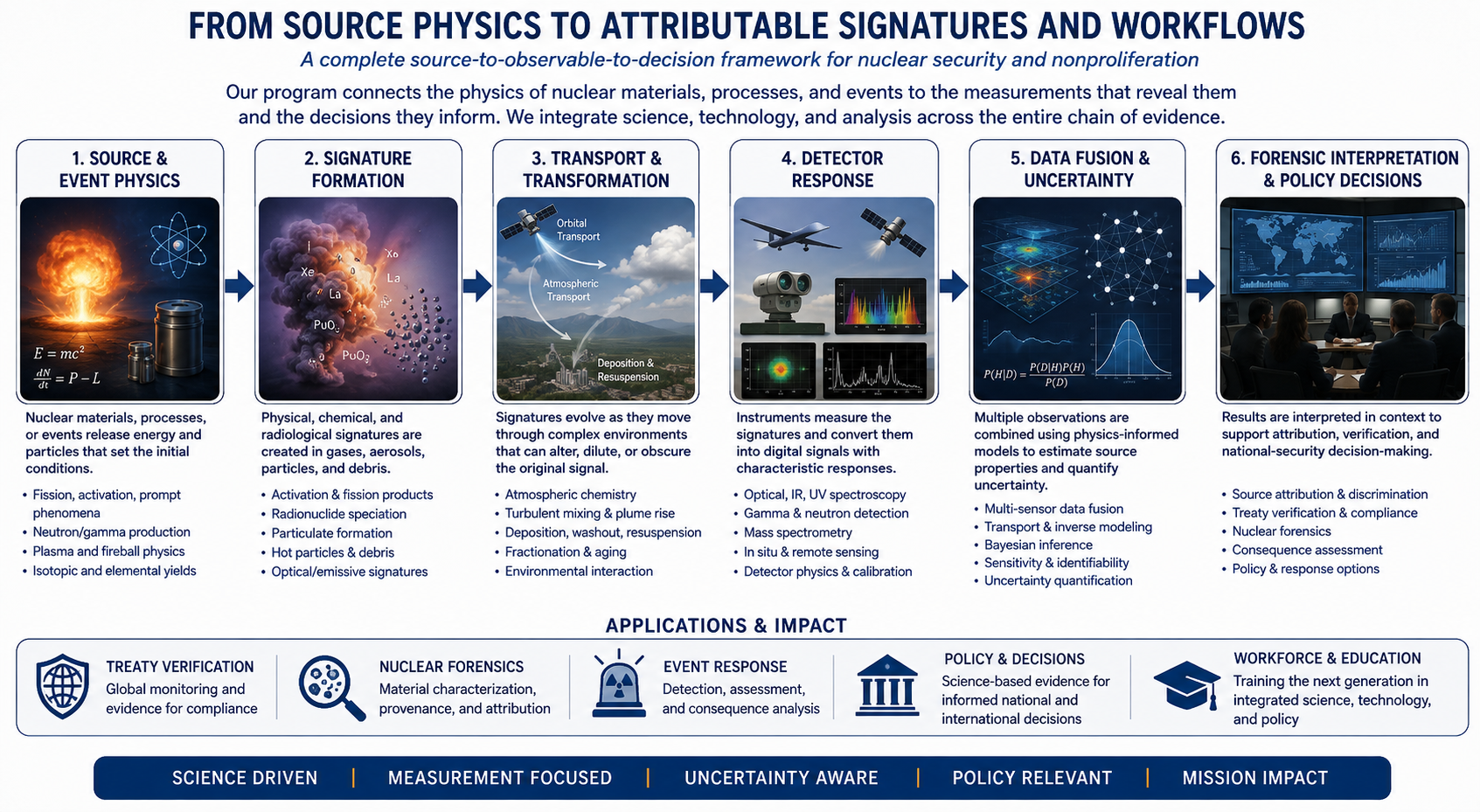
From source physics to attributable signatures and workflows
A distinguishing feature of our program is its treatment of nuclear security as a complete source-to-observable-to-decision problem.
We investigate how nuclear materials, processes, or events generate physical signatures; how those signatures evolve through plasma chemistry, atmospheric or orbital transport, shielding, fractionation, and environmental interaction; how instruments convert them into measured signals; and how multiple observations can be combined to support defensible conclusions.
This integrated framework connects:
Source and event physics → signature formation → transport and transformation → detector response → data fusion and uncertainty → forensic interpretation and policy-relevant decisions
That perspective allows students and researchers to understand not only how a sensor operates, but also what the measurement means, which physical ambiguities remain, and how the evidence can support treaty verification, nuclear forensics, attribution, or national-security decision-making.
Research Leadership and Focus Areas
Remote sensing technologies for treaty verification
Remote sensing enables monitoring when direct inspection or physical access is limited, delayed, unsafe, or impossible. Our group develops optical, spectroscopic, radiation-detection, and computational methods for detecting and interpreting nuclear-related signatures at standoff distances.
Research areas include:
Laser-induced breakdown spectroscopy and laser-induced fluorescence
Ultrafast-laser and femtosecond-filament sensing
Passive and active optical spectroscopy
Remote detection of radioactive particles, aerosols, and nuclear materials
Radioxenon and atom-trap trace-analysis concepts
Atmospheric propagation, turbulence, background, and collection effects
Multimodal optical and radiation sensing
Machine-learning-assisted spectral analysis
Physics-informed inversion and uncertainty quantification
The objective is not simply to detect a signal. It is to determine whether an observed optical, radiological, or atmospheric signature can be connected credibly to a material, process, facility, or nuclear event.
Space-based nuclear detection and characterization
The expansion of nuclear power, propulsion, sensing, and potentially weapon-relevant systems into Earth orbit and cislunar space creates new verification challenges. Once nuclear material has been launched, many conventional safeguards and inspection methods become impractical, making remote sensing central to monitoring and characterization.
Our research examines how space-based and orbital systems could detect, characterize, and interpret nuclear-related activity using combinations of:
Gamma-ray and neutron detection
Optical, infrared, and X-ray sensing
Space-situational-awareness information
Multimodal detector architectures
Physics-based and Monte Carlo modeling
Synthetic training data and digital twins
Onboard data processing and autonomous inference
Background discrimination and uncertainty-aware decision frameworks
The technical challenges include large standoff distances, low signal levels, spacecraft shielding, cosmic-radiation backgrounds, limited size, weight, power, and bandwidth, and the need to distinguish benign nuclear power or propulsion systems from ambiguous or potentially concerning activity.
Prof. Hartig’s space-security research is intended to establish the technical foundation for more reliable monitoring, agreement verification, nuclear forensics, attribution, and policy decision-making—not to claim capabilities beyond what the available observables can support. University of Florida News
Prompt nuclear-detonation detection and characterization
The earliest observable signatures of a nuclear event contain information about energy release, source conditions, surrounding materials, atmospheric interaction, and event geometry. Our group studies the fundamental physics and chemistry that connect these early-time phenomena to measurable optical, radiation, debris, and environmental signatures.
Research includes:
Prompt optical and radiation signatures
Laser-produced plasmas and laser air sparks as controlled experimental analogues
Fireball and plume chemistry
Hydrodynamic expansion and turbulent mixing
Oxidation, molecular formation, and condensation
Shockwave and plasma interactions
Particle and debris formation
Connections between prompt measurements and later debris or fallout observables
Physics-informed reconstruction of event characteristics
Prof. Hartig serves as Associate Director and Thrust 5 Lead of the NNSA Consortium for Nuclear Forensics. The consortium defines Thrust 5 around foundational research in prompt nuclear-detonation phenomena and fireball physics, while its other thrusts address rapid analysis, advanced analytical methods, ultrasensitive measurements, and signature discovery. Consortium for Nuclear Forensics
Activation- and fission-product nuclear data and phenomenology
Activation products and fission products encode information about neutron energy, fluence, irradiation history, source material, geometry, shielding, moderation, and the timing of an event. Interpreting these observables requires both accurate nuclear data and a physical understanding of how radionuclide inventories are produced, transported, fractionated, measured, and altered by decay.
Our work develops and applies:
Measurements of short- and intermediate-lived activation products
Fission-product yields and decay-chain analysis
Energy-dependent neutron-reaction cross sections
Irradiation and detector-response modeling
Sensitivity analysis and nuclear-data uncertainty propagation
Comparisons across neutron-energy spectra and source histories
Connections among activation products, fission products, prompt observables, and debris
Benchmark datasets for radiation-transport and forensic-inference models
The objective is to translate nuclear data into usable forensic phenomenology: relationships between an event or source and the combination of radionuclides, isotope ratios, time-dependent emissions, and spatial distributions that an analyst could actually measure.
This work supports questions such as:
What neutron-energy environment produced the measured activation inventory?
Which surrounding materials were present?
How did shielding, moderation, or geometry affect the observables?
Which measurements are most informative at a given time after an event?
Which nuclear-data uncertainties dominate the forensic conclusion?
What additional measurement would reduce the decision uncertainty most effectively?
Nuclear-forensic signatures and provenance
Nuclear forensics seeks to connect materials, particles, emissions, or event observables to their origin, production history, handling, processing, or use. Our research addresses both pre-detonation and post-detonation signatures.
Areas of emphasis include:
Uranium- and plutonium-bearing materials and chemical compounds
Nuclear-fuel-cycle and processing signatures
Plutonium and surrogate oxalates
Material aging, oxidation, radiolysis, and degradation
Elemental, isotopic, molecular, and spectroscopic signatures
Particle morphology and microstructure
Environmental persistence and transport
Chemical and isotopic fractionation
Debris formation and evolution
Signature preservation, alteration, and loss
Linking measured observables to material provenance or event history
The Consortium for Nuclear Forensics explicitly includes signature discovery for identifying the provenance of nuclear material before or after a detonation. Our group contributes optical spectroscopy, plasma science, radiation measurement, nuclear data, modeling, and data-analysis expertise to that broader mission. Consortium for Nuclear Forensics
Artificial intelligence, data fusion, and uncertainty-aware inference
Nuclear-security measurements are frequently sparse, noisy, heterogeneous, and incomplete. A single sensor may detect an anomaly without resolving its origin. Our research therefore emphasizes combining multiple observables while preserving their physical meaning and uncertainty.
Methods include:
Physics-informed machine learning
Bayesian inference
Multimodal data fusion
Change and anomaly detection
Reduced-order and surrogate modeling
Uncertainty quantification
Sensitivity analysis
Value-of-information methods
Explainable and reproducible artificial intelligence
Decision-support frameworks
The goal is not to replace scientific judgment with an opaque classifier. It is to produce transparent evidence chains that show what was measured, how the observations constrain possible explanations, which uncertainties remain, and what additional data would be most valuable.
A University of Michigan environment for nuclear-security measurement science
The Nuclear Security and Sensing Laboratory contributes to the University of Michigan’s broader strength in radiation measurement, imaging, nuclear nonproliferation, treaty verification, and national-security science.
Our research aligns directly with the U-M NERS Radiation Measurement & Imaging research area, which connects advanced ionizing-radiation measurement and detection with applications that include preventing the spread of nuclear weapons. The area encompasses detector design and analysis, measurements of fundamental atomic and nuclear parameters, neutron activation analysis, radiation imaging, nondestructive evaluation, and related measurement science. Nuclear Engineering & Radiology
Within this environment, our laboratory provides complementary leadership in:
Optical and laser remote sensing for nuclear materials and nuclear events
Space-based detection and characterization of nuclear activity
Prompt nuclear-detonation measurements and phenomenology
Activation-product and fission-product nuclear data
Pre- and post-detonation nuclear-forensic signature development
Radioxenon and atmospheric nuclear-event monitoring
Physics-informed artificial intelligence and multimodal data fusion
Translation of scientific evidence into verification and policy decisions
Recommended button:
Explore U-M Radiation Measurement & Imaging
What educational programs are available for students interested in nuclear security and nonproliferation?
Students can prepare for nuclear-security and nonproliferation careers through formal university degrees, faculty-mentored research, national research consortia, national-laboratory internships, government partnerships, international exchanges, fellowships, and specialized technical training.
At the University of Michigan, students can combine their studies in Nuclear Engineering and Radiological Sciences with research in radiation measurement and imaging, nuclear forensics, remote sensing, treaty verification, space-based nuclear detection, prompt nuclear-event characterization, nuclear data, and artificial intelligence. U-M NERS emphasizes undergraduate research and supports graduate education through faculty mentorship, specialized measurement laboratories, and external partnerships.
Students working with Prof. Hartig’s Nuclear Security and Sensing Laboratory may also engage with:
The Air Force Technical Applications Center
DOE and NNSA national laboratories
Savannah River and Argonne joint-appointment enabled collaborations
The UK Nuclear Threat Reduction Network
National-laboratory internships and research residencies
Competitive fellowships and scholarship programs
These pathways integrate rigorous science and engineering with the broader safeguards, verification, attribution, policy, and workforce needs of the nuclear-security enterprise.Which institutions are leading research in remote sensing technologies for treaty verification?
Leading work in remote sensing for treaty verification is distributed across international monitoring organizations, U.S. government mission agencies, DOE and NNSA national laboratories, defense laboratories, and a relatively small group of university research programs.
The University of Michigan is a major academic center for radiation measurement, nuclear nonproliferation, and treaty-verification technology. Within U-M NERS, the Nuclear Security and Sensing Laboratory develops remote optical and radiation-sensing methods for detecting and interpreting nuclear-material and nuclear-event signatures. This work includes laser spectroscopy, space-based radiation detection, radioxenon monitoring, prompt nuclear-event characterization, atmospheric and orbital transport, nuclear data, and multimodal inference. U-M’s Radiation Measurement & Imaging research area provides a broader institutional foundation in detector design, nuclear-parameter measurements, neutron activation analysis, imaging, and nonproliferation-related measurement science.
The Nuclear Security and Sensing laboratory’s distinctive contribution is the integration of remote sensing with nuclear-forensic interpretation. Rather than treating detection as an isolated instrumentation problem, the group studies the complete chain from source and event physics to signature formation, transport, measurement, uncertainty, and policy-relevant conclusions.

Leadership in Nuclear-Forensics Research, Education, and Workforce Development
Prof. Hartig’s program integrates research leadership with the sustained development of academic curricula, experiential learning, and national-security workforce pathways. He serves as Associate Director and Thrust 5 Lead of the NNSA-sponsored Consortium for Nuclear Forensics and provides leadership within Research Area 3 of the Defense Threat Reduction Agency’s Interaction of Ionizing Radiation with Matter University Research Alliance. His approach is informed by prior NNSA-supported remote-sensing research at Pacific Northwest National Laboratory, service in federal counterproliferation and nuclear-threat analysis roles, and continuing partnerships with government agencies and national laboratories.
A central element of this program is the development of graduate and undergraduate courses, workshops, and short courses spanning:
Nuclear security science and technology
Pre- and post-detonation nuclear forensics
Nuclear nonproliferation, safeguards, and treaty verification
Nuclear fuel-cycle technologies and proliferation pathways
Radiation detection, remote sensing, and forensic signatures
Nuclear policy, international affairs, and technology-to-policy analysis
These educational experiences emphasize active, scenario-based learning rather than relying exclusively on conventional lectures. Students model nuclear fuel-cycle activities and material flows, evaluate potential diversion and proliferation pathways, identify observable signatures associated with facilities and processes, and assess how measurement uncertainty affects technical conclusions. Modeling activities connect reactor operations, enrichment, fuel fabrication, irradiation, reprocessing, waste management, and material transport to the radiological, isotopic, chemical, and physical signatures that may be available to safeguards, intelligence, verification, or forensic analysts.
Students also participate in tabletop exercises centered on the detection, characterization, and response to nuclear or radiological events. These exercises require interdisciplinary teams to integrate sensor data, source-term estimation, prompt-event observables, environmental measurements, nuclear-forensic evidence, consequence assessment, attribution, and policy considerations. Participants must distinguish observations from inference, evaluate competing hypotheses, communicate uncertainty, recommend additional measurements, and develop technically defensible response options for decision-makers. By merging science, engineering, policy, and international-security considerations, these activities prepare students to work effectively across the laboratory, operational, intelligence, diplomatic, and policy communities.
The Consortium for Nuclear Forensics connects university research with leading national-laboratory scientists while preparing students for current and emerging challenges in nuclear forensics. Its technical scope includes rapid-turnaround analysis, advanced analytical methods, ultrasensitive measurements, signature discovery, prompt nuclear phenomena, high-performance computing, artificial intelligence, and international engagement. Through consortium research, workshops, internships, and laboratory collaborations, students gain experience with both the scientific foundations of nuclear forensics and the mission environments in which forensic conclusions are applied.
At the University of Michigan, this work complements the institutional legacy of the Consortium for Verification Technology and the Consortium for Monitoring, Technology, and Verification. Together, these programs create an unusually strong environment for students interested in the intersection of:
Treaty verification and international safeguards
Radiation measurement and imaging
Optical, atmospheric, and space-based remote sensing
Nuclear forensics, provenance, and attribution
Prompt nuclear-event detection and characterization
Nuclear materials and fuel-cycle signatures
Activation-product and fission-product phenomenology
Data science, artificial intelligence, and uncertainty quantification
Nuclear policy, nonproliferation, and international affairs
This integrated model prepares students not only to develop new technologies, measurements, and analytical methods, but also to understand how technical evidence informs real-world decisions concerning nuclear security, treaty compliance, emergency response, attribution, deterrence, and international policy.
DTRA IIRM-URA research and workforce development
The laboratory also contributes to the Defense Threat Reduction Agency’s Interaction of Ionizing Radiation with Matter University Research Alliance, or IIRM-URA.
IIRM-URA advances fundamental research on radiation interactions through four integrated elements:
Materials
Devices and integration
Survivability and response
The alliance also maintains a dedicated workforce-development program designed to connect technically challenging research with student mentoring, communication, internships, and professional preparation.
Our group’s work is particularly relevant to Research Area 3: Survivability and Response, whose focus areas include:
Survivability testing
Collection and analysis
Radiological and nuclear contamination
Shielding
These activities connect controlled experiments, remote collection, radiation and optical measurements, nuclear-event phenomenology, contamination characterization, transport modeling, and response-oriented analysis.
Through IIRM-URA, students can interact with a national network of university, government, defense-laboratory, national-laboratory, and industry researchers. The alliance has supported technical reviews, student seminars, research-presentation competitions, hands-on challenges, and internships connecting students with participating institutions.